Your architecture map, always up to date.
Archplorer automatically discovers your applications, their dependencies, their owners and their deployment environments — directly from your code, your pipelines and your cloud. No file to maintain by hand.
Read-only agents · Deployed in your infrastructure · No inbound access to your systems
The most recent architecture diagram in your organisation is six months old.
And it was already wrong the day it was drawn. Classic developer portals just move the problem: instead of an outdated diagram, you get hundreds of catalogue files that nobody maintains any more.
A breach hits. You lose three days.
A critical CVE is published for a widely used library. Nobody knows which applications embed it, in which versions, or who maintains them.
Nobody knows who owns what.
The service goes down. The team that wrote it has been reorganised twice since. The documentation points to a disabled e-mail address.
Every new hire costs six weeks.
A new architect has to mentally rebuild the whole system from scattered conversations and Git repositories.
Your agents scan. The Hub maps. You validate.
Archplorer is built on a strict Hub & Spoke architecture. Agents run on your side and push their results to the Hub. The Hub never initiates any call to your systems.
Deploy the agents
A command-line tool, installed in your CI or on a runner of your choice. It reads your repositories, your dependency manifests, your pipelines and your cloud resources. Read-only.
The Hub builds the graph
Applications, executables, repositories, libraries, environments, teams and domains are linked in a queryable graph. Every new scan brings the map up to date.
You validate what matters
No link is ever created automatically. Uncertain matches land in a review queue, with a confidence score and a justification. You accept or reject them.
Graph, catalogue, dependency matrix, review queue. No outbound connection to your infrastructure.
Query your architecture like a database.
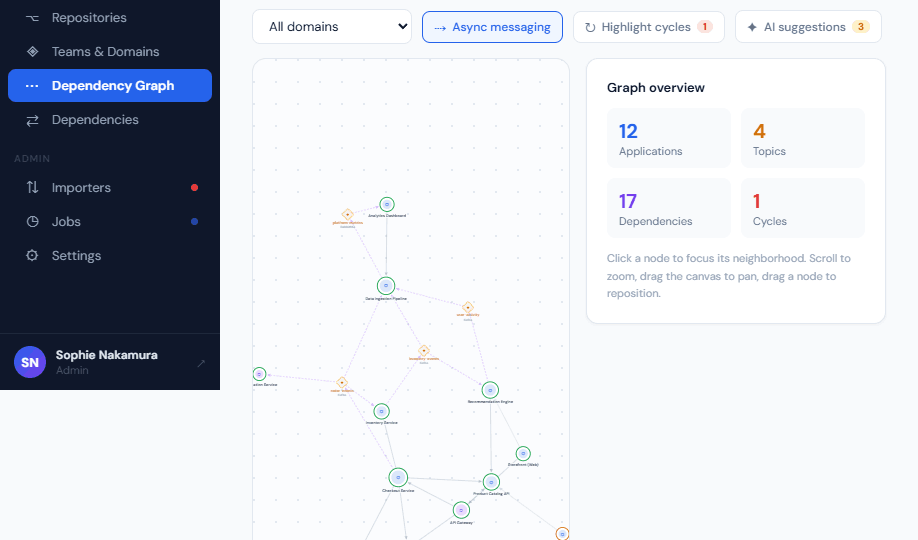
Every relationship is projected into a graph. Questions that used to take a meeting now take a second.
Blast radius
Every application that depends on this one, directly or indirectly, with its depth. Before you deploy, not after.
Shortest path
How does application A reach application B? The exact path, hop by hop, with the type of each dependency.
Cycle detection
Circular dependencies between applications, surfaced automatically.
Library consumers
Who uses this library, in which version, and with what vulnerability status.
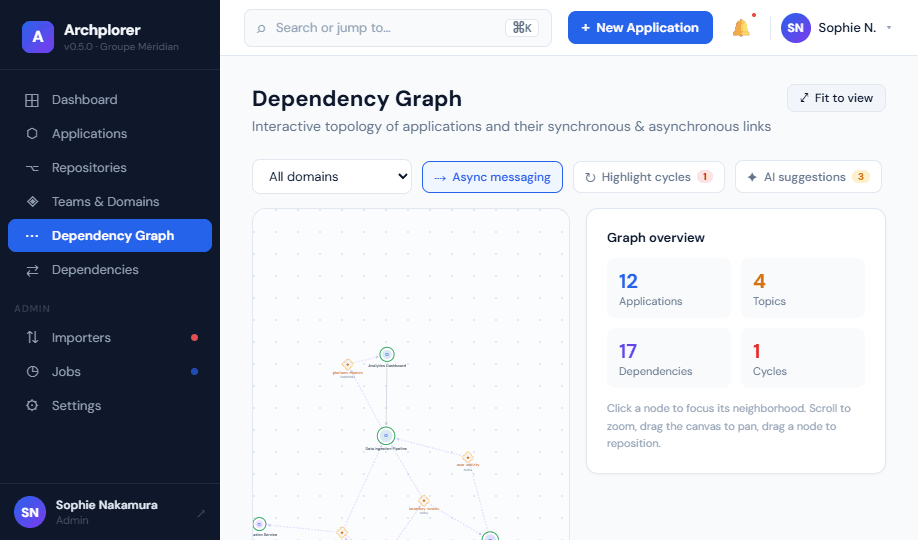
12 applications · 17 dependencies · 4 topics · 1 cycle
When the next critical vulnerability lands, you already have the answer.
Every library in every application is inventoried, versioned, and continuously checked against public vulnerability databases.
Five ecosystems covered
NuGet · npm · Maven · PyPI · Go — from your real manifests, not from a declaration.
Vulnerability and licence status
For every package, in every application, in every deployed version.
From library to team in two clicks
Trace a library up to the application, then to the team responsible for it.
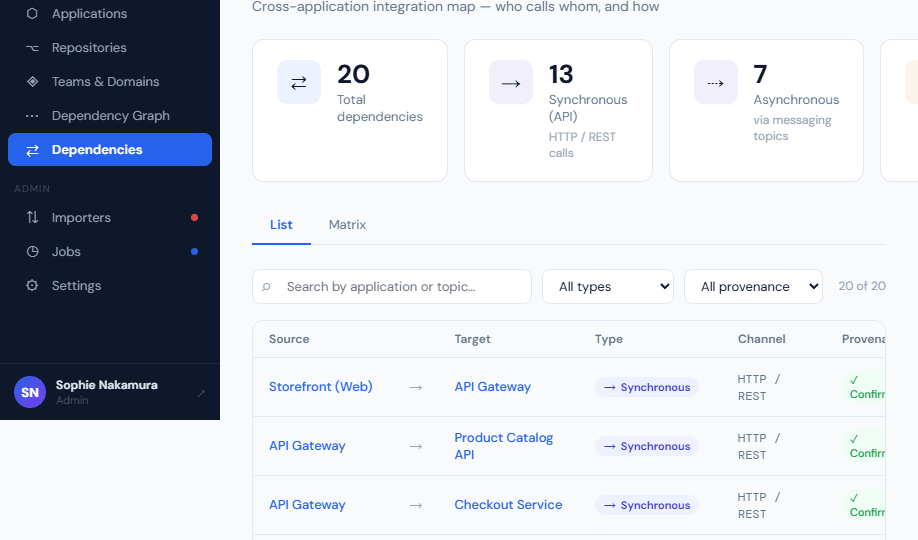
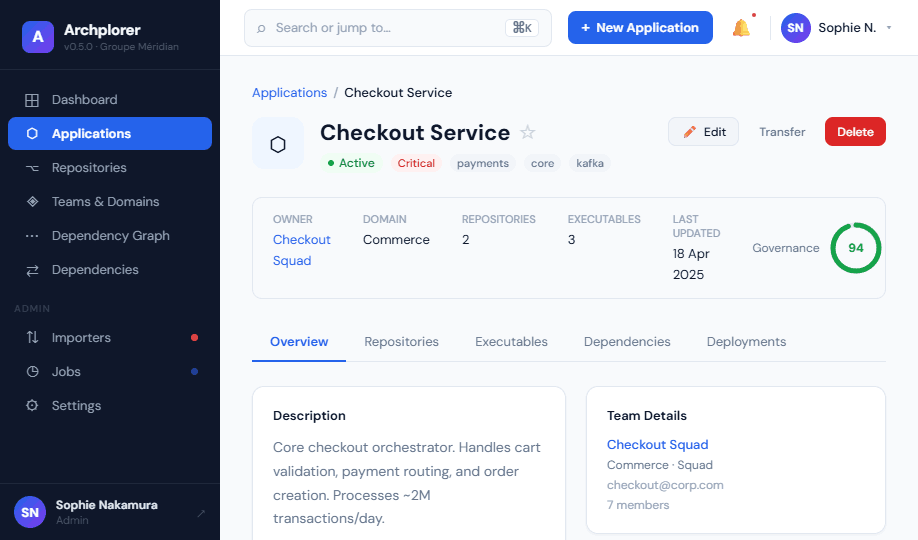
Every application, its full profile. No manual entry.
The catalogue
All your applications, filterable by business domain, owning team, criticality and lifecycle stage. A governance score flags orphaned or incomplete applications.
The service profile
For every application: its repositories, its executables, its inbound and outbound dependencies, its deployment environments, its team and its domain. Plus the list of applications it would impact if it went down.
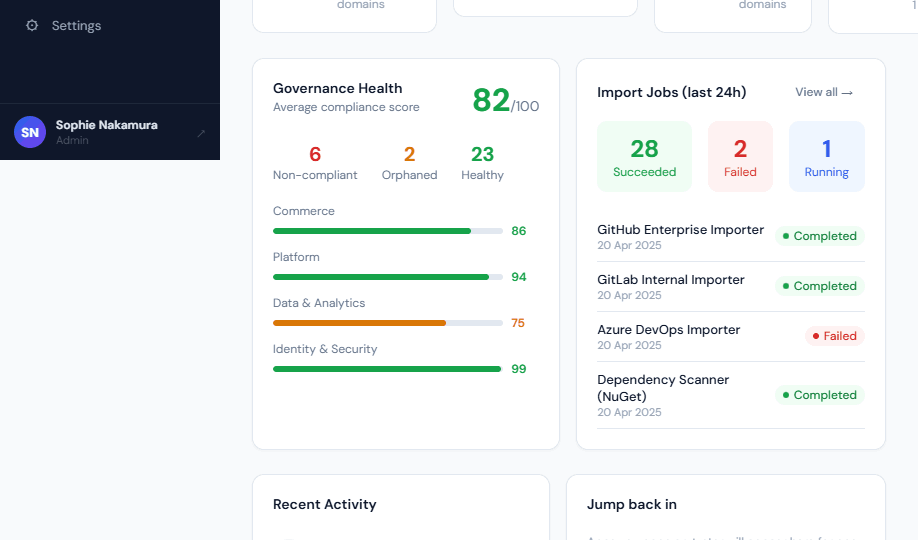
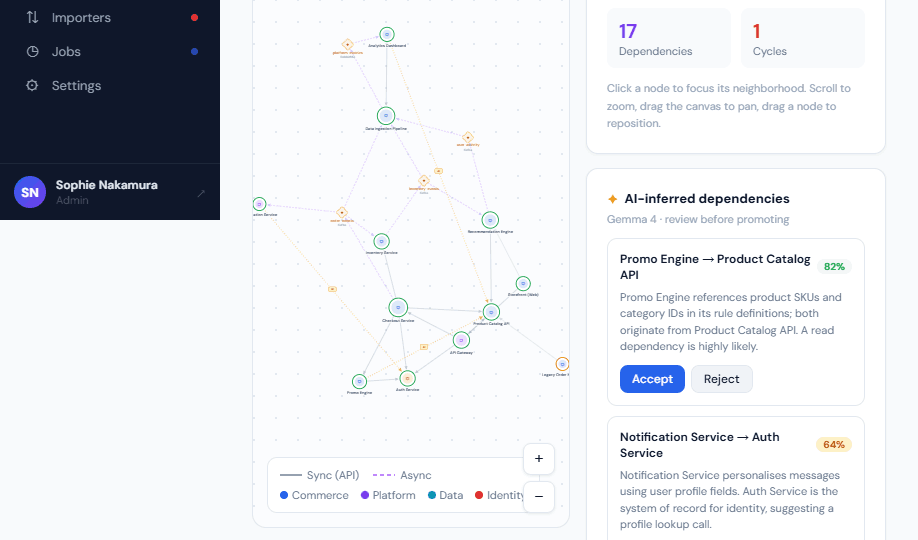
An agent that reads your code the way an architect would.
For dependencies no manifest declares — an HTTP call, a message queue, a shared database — Archplorer explores the repository and proposes the links it finds.
Autonomous exploration
The agent walks the file tree, opens the relevant files and follows leads, instead of applying a fixed list of regular expressions.
Nothing is written without you
Every proposal arrives in a review queue with its confidence score, its justification and the source file behind it. A contributor accepts or rejects it. No edge is ever created automatically.
Provenance is preserved
Every link keeps a record of its origin: exact match, approximate match, model inference, or manual entry.
Model-assisted analysis is optional and disabled by default. The heuristic analysers work entirely offline. The model endpoint is one you configure yourself.
Your agents run on your side. The Hub never sees your source code.
Archplorer is designed to keep its exposure surface minimal and verifiable.
No inbound access
The Hub never initiates a connection to your infrastructure. It needs no inbound port opened, no service account on your side, no network access to your systems.
Metadata only
Agents transmit names, versions, URLs and relationships. Source code never leaves your agents to reach the Hub.
Read-only
Agents write nothing, modify nothing, trigger nothing in your systems.
Optional assisted analysis
Language-model analysis is disabled by default. When enabled, the endpoint is the one you configure — including a gateway hosted in your own environment.
It discovers what you already use.
No changes needed in your repositories. No file to add.
On the cloud: App Service, Azure Functions, AKS, Container Instances, Lambda, ECS, EC2, Cloud Run, Cloud Functions, GKE and Compute Engine.
Explore a complete system landscape, right now.
A pre-populated demo environment, no sign-up required. Click an application, trace its dependencies, measure its blast radius.
Pricing that scales with the size of your system landscape.
Pricing on request.
Team
One organisation, a narrow scope.
- Service catalogue
- Graph explorer
- Git and dependency scanning
- Five ecosystems
Enterprise
RecommendedMultiple business domains, multiple teams.
- Everything in Team
- Cloud scanning on AWS, Azure and GCP
- Assisted discovery
- Governance score
- Roles and permissions
Custom
Regulatory constraints or a specific scope.
- Everything in Enterprise
- Dedicated model endpoint
- Deployment support
- Priority support
Archplorer is under active construction. Our partner programme will open soon: it will give a small number of organisations early access and a direct line to the team to help shape the product with us. If your system landscape is complex and poorly documented, that's exactly the context that interests us.
Let's look at your architecture together.
Thirty minutes. We'll show you the product on a system landscape comparable to yours, and answer your integration and security questions.